
ImagineerGames Explains Cross-Platform Play and Cloud Gaming opens with a clear promise: players can expect unified accounts, larger pools, and device-agnostic access. In 2026, these systems are no longer futuristic experiments, they shape who you queue with, where your progress lives, and which devices can run top-tier titles. This guide cuts to the facts gamers care about: how matchmaking works, what cross-progression actually protects, how cloud streams move pixels, and where both trends combine to change the business of play.
Table of Contents
ToggleKey Takeaways
- ImagineerGames highlights that cross-platform play unifies player accounts and pools across PC, console, and mobile, speeding up matchmaking and enabling multi-device progression.
- Cross-progression ensures player progress, cosmetics, and purchases follow their account across devices, reducing repurchase frustration and enhancing gameplay continuity.
- Cloud gaming streams games from remote servers with low latency, allowing play on diverse devices like phones, tablets, and smart TVs while maintaining consistent performance.
- Combining cross-platform play with cloud gaming lowers barriers to entry, increases player retention, and extends the commercial lifespan of multiplayer titles.
- Technical challenges like latency and input fairness are addressed through server proximity, adaptive streaming, and input-based matchmaking to balance competitive integrity.
- Security is strengthened by centralizing game logic on servers and employing encryption, authentication, and fraud detection to protect accounts and purchases.
Cross-Platform Play Explained: Matchmaking, Progression, And Fair Play
Fact first: cross-platform play aggregates players across PC, console, and mobile so matchmaking is faster and lifespans extend. Matchmaking: studios now pool users from multiple storefronts to reduce queue times and revive niche modes. To keep competition fair, many games use input-based matchmaking that separates keyboard-and-mouse from controller and touch. That choice explains why some ranked matches only show controller icons or why a toggle lets a user opt out of cross-play.
Progression: cross-progression ties a player’s levels, cosmetic unlocks, and purchases to a publisher account rather than a single device. When a player links an account, their inventory follows from phone to console to PC. That model reduces re-buy frustration and supports multi-device play but requires publishers to secure account systems and manage refunds across platforms.
Fair play: developers balance fairness with practical limits. They adjust aim-assist, remap input windows, and sometimes cap frame rate differences in competitive playlists. ImagineerGames has covered how platform loyalty still affects choices, and developers still wrestle with where hardware advantages persist in spite of unified matchmaking. For a broader context on cross-play’s rise, see how How Cross-Platform Play Became increased player pools and social networks.
Cloud Gaming And How It Works: Streaming, Latency, And Device Support
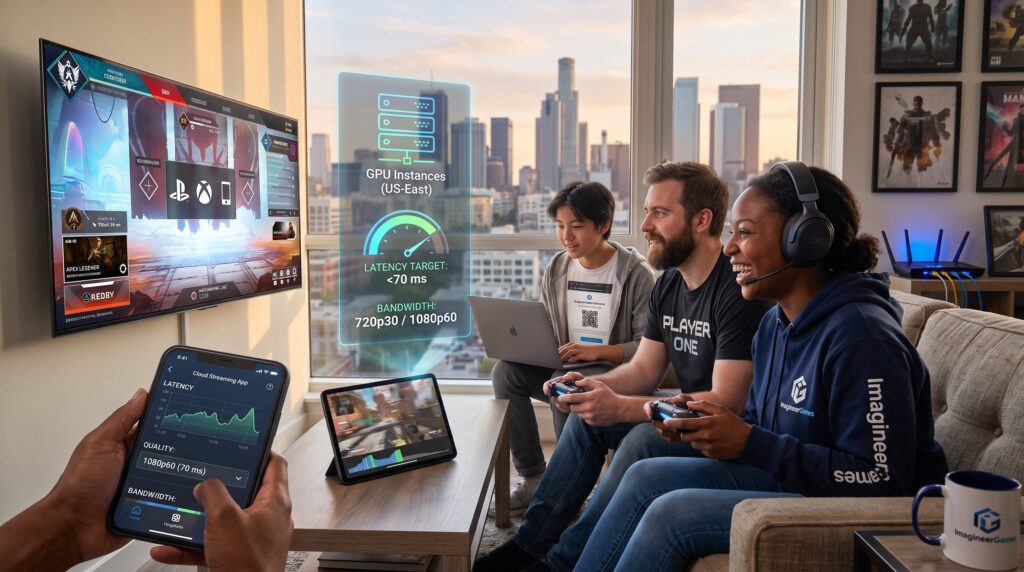
Fact first: cloud gaming runs the game on remote servers and streams compressed video to the player while sending inputs back in real time. Streaming mechanics: a server renders frames, encodes them, and sends them over low-latency protocols to a client app or browser. The client captures controller, touch, or keyboard input and relays it back: good services aim for sub-80ms round-trip latency for action titles.
Latency and network needs: latency is the delay between a user’s input and the server’s visual response. Low-latency fiber or 5G and regional edge data centers reduce that delay. Services use adaptive bitrate to keep visuals steady when bandwidth dips and WebRTC or QUIC to trim transport lag.
Device support: cloud platforms now list phones, tablets, laptops, smart TVs, and even handhelds as supported devices. That means a player can jump from a gaming laptop to a midrange phone and keep playing the same session, provided they connect to the same account. For a practical list of crossplay on PlayStation platforms, which often factor into device support decisions, consult the PS5/PS4 crossplay guide from PushSquare.
Where Cross-Platform And Cloud Gaming Meet: Player Benefits And Ecosystem Effects
Fact first: combining cross-platform systems with cloud gaming creates larger communities, smoother access, and stronger retention. Player benefits: cloud streaming lets players join large cross-play pools on underpowered devices: cross-progression means purchases and ranks travel with the account: together they lower barriers to entry and shorten matchmaking wait times.
Ecosystem effects: publishers see longer lifespans for multiplayer titles and higher lifetime value because players can rejoin from any device. Games that support both cloud and cross-progression tend to keep more concurrent users, which improves matchmaking quality and fosters healthier communities. ImagineerGames‘ coverage of gaming communities shows how broader access reshapes social patterns and platform decisions.
Practical example: a player who bought a seasonal battle pass on console can change to a mobile cloud session while traveling, keep the same unlocks, and still match against the same pool of players. That continuity increases engagement and reduces churn. For a look at how studios build fast, secure systems to enable those flows, see the piece on imagineergamescom tech.
Technical Challenges And Solutions (Latency, Input, Security)
Fact first: latency, input parity, and security are the three technical hurdles that determine whether cross-cloud experiences feel playable. Latency & input: the primary fix is geographic distribution, placing servers closer to players with edge data centers. Services use transports like WebRTC and QUIC plus adaptive frame prediction to mask small delays. Input-based matchmaking and optional control locks prevent keyboard-and-mouse players from dominating controller-only playlists.
Security: cloud execution centralizes game logic on servers, shrinking the attack surface for client-side cheats. But centralized systems must secure account credentials and in-transit data with hardened authentication and encryption. Publishers add device-link flows and fraud-detection signals to stop account theft and protect purchases.
Network optimization and failure modes: adaptive bitrate keeps streams stable but can introduce visual lag when bandwidth falls. Developers design fallback rules, lower resolution, reduced effects, or switching to lower-fidelity local logic, so gameplay remains functional. For insights into how localization and geography still influence server placement and latency, refer to the analysis of why geography still matters.
Honest trade-offs: some competitive players still prefer native installs because sub-50ms latency is easier to achieve locally. Teams must balance broad access with pro-grade performance, and that sometimes means segmented playlists or device-specific leaderboards. ImagineerGames’ coverage of platform loyalty shows how those choices influence which games players actually commit to over time.
Conclusion
Cross-platform play and cloud gaming together create a device-agnostic world where accounts, progress, and communities persist across hardware. The combination widens pools, speeds matchmaking, and extends a title’s commercial life. Players and studios should expect more choice, and more technical trade-offs, so informed decisions about input, network, and account security will matter more than ever.