
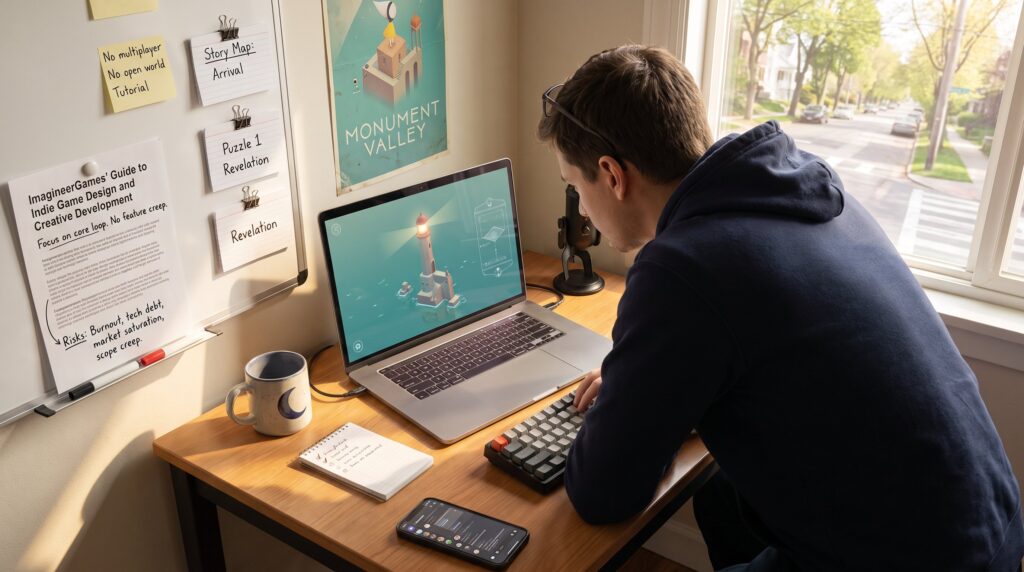
Indie game design is where small teams and solo creators turn sharp ideas into playable delights. This guide frames contemporary indie practice for 2026: why the market matters, how to shrink scope without killing ambition, prototype fast, pick pragmatic tools, and launch with community-first tactics. It pulls specific, research-backed patterns, core loops, five-to-ten playtests, MVP prototyping, and honest lessons from small studios. Readers will get practical steps they can apply to a 5–15 minute game prototype, plus links to deeper ImagineerGames resources for narrative, production, and studio tech.
Table of Contents
ToggleKey Takeaways
- Indie game design in 2026 thrives by focusing on one core fantasy, one main mechanic, and disciplined scope to create memorable, compact experiences.
- Rapid prototyping and rigorous playtesting, including five-to-ten targeted playtests, are essential to validate fun and clarity before heavy art investment.
- Selecting pragmatic tools like Unity or Godot and maintaining streamlined workflows with MVP-first development accelerates polished game delivery.
- Small teams should assign clear roles and limit scope accordingly, while solo developers benefit from outsourcing art or audio to stay lean and focused.
- Launching with community-first tactics—building an engaged audience early and iterating via demos and early access—ensures sustainable growth and monetization.
- Marketing should emphasize the core loop’s clarity, using focused press kits and short gameplay clips to attract influencers and niche players effectively.
Why Indie Games Matter Now — Trends, Opportunities, And Goals
Indie games matter because they trade scale for focused experiences, niche communities, and repeatable studio careers. Tens of thousands of indie titles ship each year, and creators who lean into short, resonant experiences now capture attention more reliably than chasing AAA spectacle. Concrete trend: many indie teams now treat publishing as a sustainable business model, releasing sequels and side projects rather than single-hit gambles.
Opportunity appears in specialty audiences. For example, narrative-first players seek single-session stories, while speedrun communities prize tight mechanical clarity. ImagineerGames has documented this shift in depth in The Evolution of Narrative where storytelling choices align with commercial niches.
Practical goal-setting for 2026: pick one player emotion, one main mechanic, and one target platform. This trio converts vague ambition into measurable milestones, scope, prototype, and launch readiness, so teams avoid feature creep and deliver memorable play in compact form.
Turning Ideas Into Playable Concepts — Concepting, Scope, And Research
Start with the clear fact: the best indie concepts begin as a single playable sentence. That sentence defines the core fantasy and core loop before art or code.
Define the playable sentence (example): “A blind courier navigates tactile sound puzzles to reach a safehouse in ten minutes.” From that sentence the team extracts one mechanic (sound-based navigation), one measurable loop (sense → decide → move → reward), and a scope target (5–15 minute run).
Research follows three steps: 1) competitive mapping, list 5 similar titles and note what they deliver in five-minute tests: 2) technical feasibility, confirm a chosen engine can run your mechanic at target frame rates: 3) audience signals, scan niche communities and influencer coverage for fit. ImagineerGames’ process overview in How a Video Game Is Made maps these stages to realistic timeframes.
A practical warning: avoid compounding scope risks. If multiplayer, procedural generation, or a complex economy enter a first project, cut them or push to a later project. Many solo devs fail by adding one big risk too many.
Core Design Principles And Prototyping Techniques
Fact first: prototypes must test the core loop, not graphics. Build the smallest possible version that proves the fun.
Three prototyping techniques deliver quick answers: minimum viable prototype (MVP) focused on loop feel: greyboxing to test space and camera with simple geometry: and narrative or paper prototypes (Twine or flowcharts) to test story beats and branching choices. Teams that combine these methods decide faster and waste less art time.
Practical metrics and rituals: timebox iterations to one week, run five targeted playtests per build, and ask exactly three questions, Is it fun? Is it clear? Can a player complete it in the target time? For narrative experiments, compare player completion paths and note where pacing stalls.
A real lesson: one studio reported scrapping six hours of art after a greybox proved the camera broke the mechanic. That painful deletion saved months of polish later. Prioritize early, cheap falsification over late, expensive fixes.
Building The Game: Tools, Workflow, And Team Strategies
The direct insight: pick tools that minimize friction for core loop delivery. Unity remains the default for many indie and mid-sized projects: Godot is the fastest-growing alternative for hobbyists and tight builds. For a concise primer on engines and capabilities, the technical overview at What Is a Game Engine? helps compare trade-offs.
Workflows that scale: 1) MVP-first implementation, ship a playable slice inside the first month: 2) timeboxed sprints with a clear “shippable” column: 3) recorded playtest sessions with timestamped issues. ImagineerGames’ studio tech write-up, Inside ImagineerGames.com Tech, shows how small teams document iteration to ship faster.
Practical configuration: use lightweight task labels, MVP, Shippable, Nice-to-Have, and limit the active sprint to three developers or roles to reduce coordination overhead. Keep builds automated and tagged so regression testing stays manageable.
Warning: tool-churn costs time. Resist swapping engines mid-project unless a clear, measured gain exceeds the migration cost.
Solo Vs Small Team Development — Roles, Responsibilities, And Best Practices
Clear insight: team size should match scope. Solo creators should pursue single-mechanic, single-platform projects. Small teams (2–6 people) can expand to additional systems but must codify roles.
Role breakdown for a 4-person team: designer (core loop and level), programmer (prototype and systems), artist (visuals and UI), and community/marketing lead (demos and audience). Use task tiers, MVP, shippable, above-and-beyond, to triage work. ImagineerGames’ community piece, Creative Gaming at, outlines how community roles tie into early-playtest outreach.
Best practices: document decisions in a simple living doc, run daily 15-minute syncs, and freeze feature changes two weeks before a planned demo. Solo devs should outsource art or audio rather than expand scope. A candid lesson: a solo dev once added voiced dialogue late and missed a Steam festival because localization consumed a sprint: plan those extras early or shelve them.
Launch, Monetization, And Community Growth For Indie Titles
Direct point: launch is community work, not a single release day. Start building an audience before a public demo.
Tactics that convert: release a tight playable demo to a small group, collect structured feedback, and turn early access into an iterative revenue stream. Monetization often blends premium pricing with DLC and tiered community memberships for exclusive builds. For examples of community-first growth and narrative positioning, see ImagineerGames’ overview, Discover the Gaming Magic.
Practical numbers: target 1,000 engaged followers before a public launch demo: convert 3–7% of that cohort to paying early adopters for sustainable runway. Use micro-incentives, exclusive builds, developer diaries, and small-run cosmetic items, to reward early backers.
Marketing warning: influencers amplify clarity. If the core loop is muddled, influencers will highlight flaws, not strengths. Use focused press kits, short gameplay clips, and two-line pitches that map to the playable sentence from concepting.
Conclusion
Indie success in 2026 comes from precision: one core fantasy, one main mechanic, and disciplined scope. The most reliable path is rapid prototyping, rigorous playtesting, and community-first launches. By choosing suitable tools, organizing small teams around clear roles, and monetizing with layered offers, creators build repeatable careers rather than one-off hits. ImagineerGames encourages creators to test early, fail cheap, and iterate with player feedback, practical moves that turn ideas into sustainable studios.