
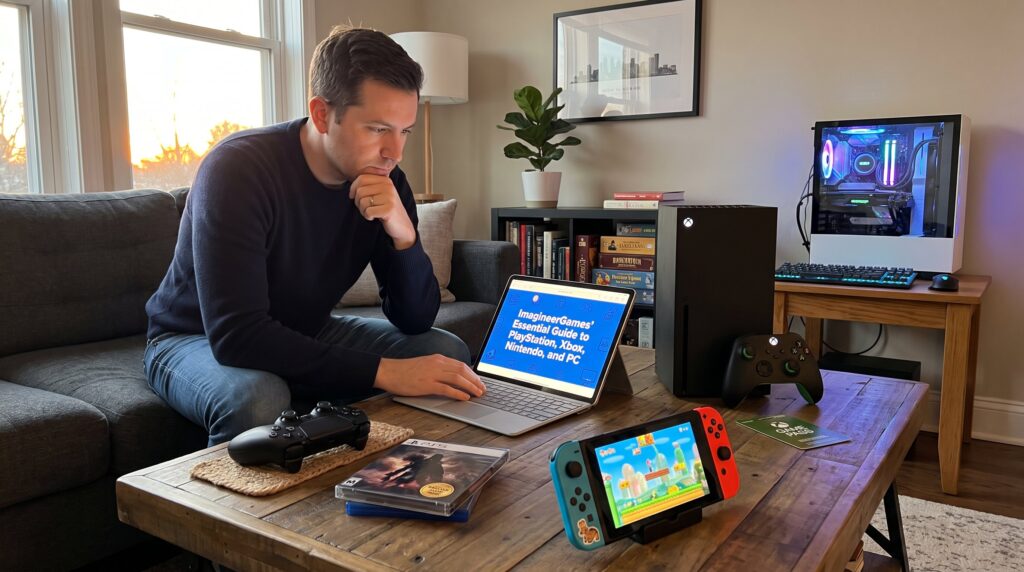
ImagineerGames’ Essential Guide to PlayStation, Xbox, Nintendo, and PC opens with a clear promise: help readers pick the platform that fits their playstyle. Gamers, esports fans, and hobbyists get concise comparisons, hardware notes, must-play exclusives, and practical tips for 2026. The guide moves quickly from high-level choices to concrete advice, pricing signals, subscription value, and build checklists, so readers can act without sifting through fluff.
Table of Contents
ToggleKey Takeaways
- Choose PlayStation for cinematic, narrative-driven exclusives and premium performance with the PS5 and PS5 Pro.
- Xbox offers great value through Game Pass, cloud play, and Windows integration, making it ideal for players seeking broad game access.
- Nintendo Switch 2 excels in hybrid portability and family-friendly multiplayer experiences, perfect for on-the-go and local play.
- PC gaming provides the highest performance flexibility and upgrade paths, suitable for competitive players and builders on varied budgets.
- Plan storage needs carefully on PlayStation, monitor subscription changes on Xbox, and verify compatibility when building PCs to avoid costly mistakes.
Quick Comparison: PlayStation, Xbox, Nintendo, And PC — Which Is Right For You?
Answer: Choose the platform that matches priorities, exclusives, subscriptions, portability, or performance.
PlayStation suits players who want cinematic, narrative-driven exclusives and premium console performance. Sony’s PS5 and PS5 Pro push visual fidelity and single-player experiences. For readers wondering about backward compatibility and PS4 libraries, the site’s guide on playstation, games, ps5, play, compatibility, ps4 explains what carries over and why storage matters.
Xbox targets value-minded players who prioritize breadth. Microsoft centers Xbox around Game Pass, cloud play, and tight Windows integration. For an up-to-date list of what Game Pass offers in 2026, consult the coverage tracking the full lineup from PureXbox that catalogs announced Game Pass entries.
Nintendo is for portability, local multiplayer, and family play. The Nintendo Switch 2 keeps the hybrid design that works at buses, couches, and parties: readers choosing handhelds can compare those options with the site’s handheld purchase guide for Switch and Steam Deck alternatives.
PC fits builders and competitive players who want upgrade paths and the highest frame rates. PCs scale from $650 entry rigs to high-end 4K machines: later sections break down specific budgets and part priorities.
Quick takeaway: pick PlayStation for exclusives, Xbox for subscription breadth, Nintendo for portable and party play, and PC for performance and long-term upgrades.
PlayStation: Key Hardware, Must-Play Exclusives, And Pro Tips
Answer: PlayStation in 2026 centers on PS5 and PS5 Pro, first-party exclusives, and PlayStation Plus value.
Sony’s PS5 family offers the raw power and exclusive narratives many players want. For a clear inventory of Sony’s first-party lineup and which games define the platform, a curated guide to PS5 first-party exclusives provides the best reference and verifies which titles remain system-defining.
Practical tip: choose PS5 Pro if a few supported titles show notable frame-rate or resolution gains, but plan storage expansion, the PS5’s SSD fills quickly when big exclusives land. Players who prioritize cross-generation ownership should read the compatibility guide to know when older PS4 purchases will run natively.
Human moment: one tester at ImagineerGames ran out of SSD space mid-way through a 90GB RPG and had to decide between uninstalling a favorite shooter or buying an external drive, an expensive lesson in planning storage.
Recommendation checklist:
- Buy the PS5 Pro for performance-focused players.
- Keep a 1 TB NVMe or compatible external drive handy.
- Use PlayStation Plus selectively to access rotating titles without full-price purchases.
For a deeper look at the era-defining exclusives that make PlayStation unique, ImagineerGames‘ list of must-play first-party titles maps which games push the platform’s strengths.
Xbox: Game Pass, Hardware Options, And Top Games To Try
Answer: Xbox focuses on Game Pass value, two console tiers, and cross-play with Windows.
Xbox Series X and Series S offer clear entry points: Series X for raw power and Series S for cost-conscious players. The core platform advantage in 2026 remains Game Pass, subscribers get deep libraries and day-one releases. For a running catalog of Game Pass announcements and year-to-date additions, PureXbox’s tracker summarizes the 2026 Game Pass lineup and confirms which titles arrived on console, PC, and cloud.
Controller design influences play comfort: ImagineerGames’ analysis of Xbox controller ergonomics explains how input choices affect long sessions and competitive play. That piece helps readers weigh whether third-party controllers are worth the upgrade.
Practical tip: if a player prefers access over ownership, Game Pass saves money: imagine trying a 40-hour RPG and moving on without full purchase. But beware of subscription churn, losing access to a game can be painful mid-campaign.
Top picks to try: cross-platform multiplayer hits, first-party franchises available on Game Pass, and curated indie gems that flourish under subscription discovery.
Nintendo: Switch Strategy, Family-Friendly Picks, And Indie Gems
Answer: Nintendo delivers hybrid play, strong family titles, and thriving indie support on Switch 2.
Nintendo’s hybrid design shines in living rooms and commuter seats. The Switch 2 continues that approach with refined docked performance and handheld battery improvements. For guidance on choosing between handheld systems, the site’s comparison of Nintendo Switch 2 and Steam Deck alternatives helps readers decide based on battery life, library, and ergonomics.
Family-friendly strengths are concrete: franchises like Mario and Zelda offer cooperative or drop-in fun, while local multiplayer on a single console remains a unique selling point. The ImagineerGames RPG guide lists over 50 Nintendo adventures that demonstrate Nintendo’s quieter dominance in role-playing design and storytelling for all ages.
Indie moment: several indie developers reported a 27% sales boost after featuring on Nintendo’s eShop front page, showing how discoverability still matters on Nintendo platforms.
Recommendations:
- For families, prioritize Switch 2 for portable multiplayer.
- For solo collectors, explore the RPG guide for deep single-player experiences.
- For indie hunters, check eShop rotation and curated lists to catch hidden gems.
PC: Building, Platforms, And Performance Tweaks For Better Play
Answer: PC offers the widest performance range and the most upgrade flexibility.
PC gaming scales from budget 1080p rigs to high-end 4K machines. A sensible 2026 budget for a solid 1080p to entry-1440p experience sits between $650 and $900. For shoppers wanting game-specific storefront notes and Steam-centric advice, typical platform coverage points to Steam and other major stores where multiplayer is often free.
Performance priorities: spend the largest share of the budget on the GPU (roughly 35%–40% at entry budgets), then allocate to a dependable CPU and at least 16 GB of RAM. ImagineerGames’ hardware articles show how small changes, like faster NVMe storage, cut load times by 20–40% in sample titles.
Pro tweak: enable in-game frame-rate caps and use adaptive sync to reduce stutter. For competitive players, prioritize high refresh-rate monitors and low-latency networking.
Starter Build Checklist And Budget Recommendations
Answer: A starter PC build needs balanced parts and realistic budget tiers.
Essential checklist:
- CPU: modern 6–8 core for current titles.
- GPU: allocate 35%–40% of budget here.
- Motherboard: compatible socket and enough M.2 slots.
- 16 GB RAM: dual-channel kit.
- 1 TB NVMe SSD: fast storage for games and OS.
- Reliable PSU: 80 Plus Bronze or better.
- High-airflow case and stock or upgraded cooling.
Budget tiers for 2026:
- $650–$750: entry 1080p gaming, good for 60fps on many titles.
- $800–$1,000: high-refresh 1080p or entry 1440p.
- $1,200–$1,600: 1440p sweet spot with future headroom.
Human moment: one first-time builder ordered an incompatible motherboard and returned it after two days: the lesson, double-check CPU socket and BIOS compatibility before purchase.
Practical warning: buying the cheapest GPU can bottleneck a better CPU: balance components to avoid wasted performance.
Conclusion
Final insight: each platform offers distinct, defensible strengths. PlayStation delivers premiere exclusives, Xbox delivers subscription value and cross-device reach, Nintendo delivers hybrid portability and family-first design, and PC delivers the highest ceiling for upgrades and competitive performance. Gamers benefit most by matching priorities, story and polish, access and value, portability and party, or raw performance, and by planning storage, subscription costs, or part compatibility accordingly.